

PETROL ENGINES

HEAT ENGINE AND ITS TYPES
The engine or machine which converts heat energy from the combustion of fuel or any other source and convert this into mechanical work is called HEAT engine. Heat engines can be broadly classified into two main categories.
A. External combustion engines (E.C. engines)
B. Internal combustion engines (I.C. engines)
External combustion engines (E.C. Engines)
The engines in which combustion of fuel takes place out side the cylinder is known as external combustion engines .In these type of engines , heat of combustion of fuel is transferred to the second fluid (water is converted into steam) which is the working fluid of cylinder e.g.,steam engines or a steam turbine plant.IN a steam engines , heat of combustion is employed to generate steam which is used in piston engine or turbine. These engines are mainly used for driving locomotives,generation of electric power etc.
Internal combustion engines (I.C. Engines)
The engines in which combustion of fuel take place inside the cylinder is known as internal combustion engines.Petrol ,gas, and diesel engines are the example of internal combustion engines.In these engines the products of combustion are directly the motive fluid.
FOUR STROKE PETROL ENGINES OR SPARK IGNITION (S.I.) ENGINES
Its also known as auto cycle engine.The for stroke petrol engine takes change in the form of air-fuel mixture. (Petrol mixed with proportional quantity of air in the carburetor).The cycle of operation are as follows:Working
1.Suction stroke
2.compression stroke
3.Power stroke
4.Exhaust stroke
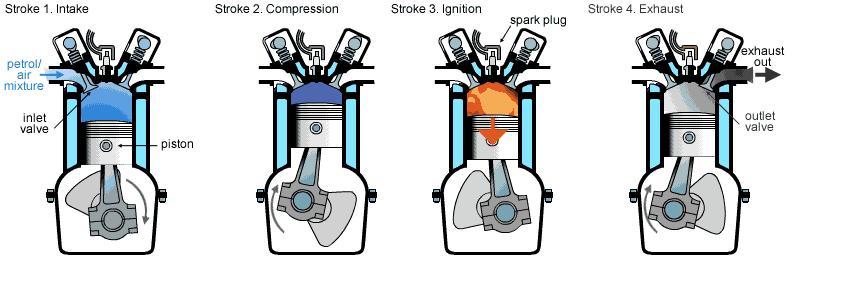
1. Suction stroke : During this stroke, the inlet valve is opened and the outlet valve is closed .When the piston moves down from the TDC (TOP DEAD CENTER), a partial vacuum is developed inside cylinder.As a result, the mixture of air and petrol is closed into the cylinder. When the piston reaches the BDC (Bottom dead center), the inlet valve closes.The flywheel makes a half-revolution.
2. Compression stroke : During the compression stroke both inlet and outlet valve is remain closed .The piston rise from the BDC to TDC and the flywheel makes another half-revolution. The mixture, which was sucked into the cylinder during the suction stroke, is compressed in the combustion chamber.The heat produce during the compression vaporizes the mixture. When the piston reaches near the TDC, a spark is produce in the spark plug. This spark is ignite the spark plug.
3. Power stroke : Both the inlet valve or exhaust valve remain closed during power stroke.The burning gas expands and pushes the piston down to the BDC. When it reaches near the BDC, the exhaust valve opens.The flywheel turns by another half-revolution.
4. Exhaust stroke : During the exhaust stroke, the inlet valve is closed and exhaust valve is open.The piston rises up from the BDC to the TDC.When the burnt gas is pushed out of the cylinder,the exhaust valve closed and the inlet valve opens with the flywheel making another a fresh mixture of air and petrol is again drawn into the cylinder. The cycle of suction, compression, power and exhaust strokes is then repeated. Thus for every cycle of operation, the flywheel rotates twice.

The all process it done .your engine will start now.
